.png)
.png)
Cost of Living in Roseville vs The Bay Area

Geoff Goolsby
I’m a trusted real estate advisor serving Roseville and the greater Sacramento area, helping thoughtful homeowners navigate buying and selling with ...
I’m a trusted real estate advisor serving Roseville and the greater Sacramento area, helping thoughtful homeowners navigate buying and selling with ...
What Does $1 Million Get You in Roseville, CA?
Bay Area transplants and out-of-state movers are discovering that a million dollars goes a lot further in Roseville — and we mean a lot further. Here's your honest, no-fluff breakdown.
If you've been house-hunting in the Bay Area — where $1 million barely clears a 2-bedroom condo in Fremont — you might be wondering what life looks like on the other side of the Altamont Pass. The short answer: considerably more square footage, a bigger backyard, and a lifestyle upgrade you didn't think was still possible in California.
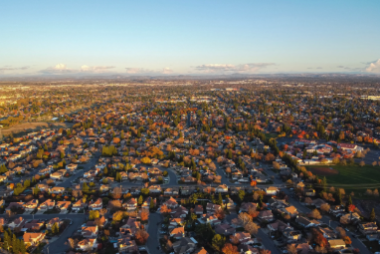
Roseville, nestled in Placer County about 20 miles northeast of Sacramento, has become one of the fastest-growing relocation destinations in Northern California. And the math isn't complicated.
THE $1M SIDE-BY-SIDE: BAY AREA VS ROSEVILLE
Let's get concrete. Here's what a $1 million budget realistically gets you in each market right now.
The headline number: The median home price in Roseville sits around $630K–$670K. At $1 million, you're firmly in the upper tier — think West Roseville's newest master-planned communities with high-end finishes, extra bedrooms for a home office or guests, and outdoor living space your Bay Area self could only dream of.

BAY AREA (Typical)
- $1,000,000
- 1,200–1,600 sq ft, 3 bed / 2 bath
- Lot size: 4,000–6,000 sq ft (tight)
- Dated kitchen and bathrooms typical
- Competitive bidding, often waived inspections
- Property tax: ~$12,000–14,000/yr
- HOA: variable, often $400–600/mo
ROSEVILLE, CA (Your dollar goes further here )
- $1,000,000
- 2,800–3,800 sq ft, 4–5 bed / 3–4 bath
- Lot: 8,000–15,000 sq ft, often with pool
- New or near-new construction, modern finishes
- 3-car garage, solar, smart home features
- Property tax: ~$11,000–13,000/yr (base)
- HOA: $100–250/mo in master-planned communities
Beyond the Mortgage
Housing is the biggest lever, but it's not the only one. Here's how everyday costs stack up — and where Roseville might actually surprise you.
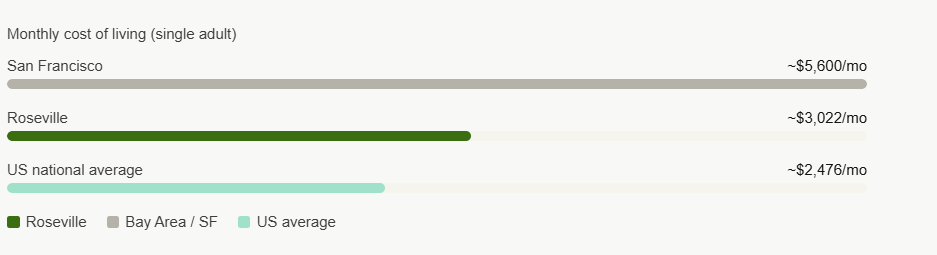
Roseville's cost of living runs about 55% lower than San Francisco — a meaningful gap that shows up in groceries, dining, entertainment, and especially childcare. Healthcare and utilities are also notably more affordable, and Roseville operates its own municipal electric utility (Roseville Electric), which means lower power bills compared to PG&E territory.
What neighborhoods should relocators know about?
Quick neighborhood cheat sheet
01 West Roseville / Fiddyment Farm — Brand-new master-planned communities with top-rated schools, parks, and a walkable village feel. Newer homes here often carry Mello-Roos (adds $150–$300/mo), but the infrastructure is immaculate.
02 East Roseville — Established tree-lined neighborhoods, no Mello-Roos, larger mature lots. Excellent value for buyers who prefer lower effective tax rates and a quieter, more settled vibe.
03 Granite Bay (adjacent) — Roseville's luxury neighbor. Larger parcels, equestrian properties, top schools. Prices climb well above $1M here. If $1M is your ceiling, you'll find better value in Roseville proper.
04 Rocklin (border community) — Prices roughly on par with Roseville, sometimes slightly higher. Worth including in your search radius.
NOTE: Mello-Roos 101: Many new Roseville homes fall inside special tax districts that fund local schools and infrastructure. On a $900K home in West Roseville, Mello-Roos could add $200–$400/month to your payment. This isn't a dealbreaker — but it IS something to budget for before you fall in love with a listing.

What about commuting and remote work?
Roseville sits on Interstate 80 — the same freeway that connects to the Bay Area. The drive to downtown Sacramento takes about 45–60 minutes in morning rush. To the Bay Area: 2 to 2.5 hours by car, or Amtrak's Capitol Corridor stops in Roseville for those who prefer the train.
For fully remote workers — increasingly the profile of Bay Area transplants moving here — commute is a non-issue. Roseville has excellent internet infrastructure (fast speeds, reliable providers) and a growing coworking scene.
THE RELOCATION REALITY CHECK: WHAT YOU GAIN, WHAT YOU TRADE
The calculus for most Bay Area transplants comes down to this: if your job is remote (or hybrid with occasional office days), Roseville's value proposition is genuinely hard to argue with. You're not making a sacrifice — you're making a trade, and many families would consider it a favorable one.
.png?w=380&h=254)
What you gain
- 2x–3x the house for your budget
- Top-rated Placer County schools
- Lower day-to-day cost of living
- 328 days of sunshine per year
- Proximity to Tahoe (90 min)
- 80+ parks, extensive trail networks
.png?w=380&h=254)
What you trade
- Bay Area job density (remote-first helps)
- Urban walkability and transit
- Coastal climate (summers are hot: avg 91°F highs)
- Proximity to SFO (2+ hrs)
- Dense restaurant / cultural scene
The 2026 market: is now a good time to buy?
The Roseville market has shifted into a steadier gear after the 2020–2022 frenzy. Median prices sit around $630K–$670K, homes are taking about 31 days to sell (up from 12 a year ago), and buyers have more negotiating room than they've had in years. Analysts expect modest appreciation of 3–4% in 2026 — stable growth, not a spike.
For those entering with cash from a Bay Area sale, Roseville's market is genuinely accessible right now. You may come in with equity, buy premium, and still have money left over.
.png?w=851)
Ready to see what $1M actually looks like here?
Let's walk you through current listings and neighborhoods that match your goals. Let us help find the right home in the right school zone for your family. Send us your email and we will curate a list of active homes in the market in Roseville right now!
We respect your inbox. We only send interesting and relevant emails.
Frequently Asked Questions:
Real answers for Bay Area families calibrating a move to Roseville.
1. We are selling our Bay Area home and will likely net $1M-$1.5M. Is that enough to buy a home in Roseville outright or do we still need a mortgage?
Yes — comfortably. Roseville's median home price is around $630K–$670K, so a Bay Area equity payout in that range puts you well into the luxury tier of the local market. At $1M you're looking at 2,800–3,800 sq ft homes with premium finishes, pools, and 3-car garages in master-planned communities. Many Bay Area transplants buy with cash and invest the difference, or take a small mortgage to preserve liquidity. Either way, your purchasing power here is a genuine upgrade.
2. How do Roseville's schools compare to the ones are kids are leaving behind in the Bay Area?
Roseville and the broader Placer County school system consistently rank among the top in California. The Roseville City School District and Roseville Joint Union High School District both earn strong ratings, and several schools rank in the top tier statewide on academic performance. West Roseville neighborhoods in particular feed into newer, well-funded campuses. Many families relocating from Cupertino, Palo Alto, and Fremont report that the school quality transition is much smoother than they expected.
Pro tip: School boundaries in West Roseville shift as new communities open. Always verify the specific school assignment for any address you're considering — don't rely on the subdivision name alone.
3. What is Mello-Roos, and should it change the neighborhood we target?
Mello-Roos is a special tax assessment tied to newer developments — it funds the roads, schools, parks, and infrastructure built alongside them. In West Roseville's newest communities, Mello-Roos can add $200–$400/month to your effective housing cost on top of your base property tax. It's not a dealbreaker — you're getting brand-new infrastructure for it — but it does affect your monthly payment math. East Roseville neighborhoods are largely Mello-Roos free, which is why many buyers who want lower ongoing costs gravitate there even though the homes are older.
4. My wife still works in the Bay Area 2-3 days a week. Is the commute actually manageable, or will it break us?
It's real distance — roughly 2 to 2.5 hours each way by car on I-80, depending on traffic. For a 2-day-a-week hybrid schedule, most families treat it as an overnighter in the Bay rather than a same-day round trip. Amtrak's Capitol Corridor also stops in Roseville and connects to Oakland and San Jose, which many commuters use to work on the train rather than drive. Fully remote workers won't feel this at all — Roseville has fast, reliable internet and a growing coworking scene. The commute question is really about frequency: 2–3 days a month is easy, 3 days a week is a lifestyle commitment.
Sacramento International Airport (SMF) is about 40 minutes away — a significant upgrade from fighting Bay Area traffic to SFO or OAK for business travel.
5. We've heard Roseville summers are brutal. How hot does it actually get, and how do families cope?
Honest answer: summers are genuinely hot. July and August see average highs around 91–95°F, with occasional heat spikes above 105°F. This is the most common culture shock for Bay Area arrivals used to mild, foggy summers. The local adaptation is real though — most homes have pools, outdoor living is designed around morning and evening hours, and Lake Tahoe (90 minutes away) becomes a regular weekend destination. Air conditioning runs hard June through September, which will show up in your utility bills. Winters are mild and pleasant, and the 328 annual days of sunshine are genuinely enjoyed the other 9 months of the year.
6. What will our day-today grocery, dining, and childcare costs actually look like compared to the Bay Area?
Overall cost of living in Roseville runs about 55% lower than San Francisco. Groceries and dining are meaningfully cheaper — you'll notice it immediately. Childcare is a significant win: a full-time daycare slot that runs $2,500–$3,500/month in the Bay Area typically costs $1,200–$1,800 in Roseville. Healthcare costs are also lower. The one area to watch is utilities — Roseville has its own municipal electric utility (Roseville Electric) which generally results in lower bills than PG&E, but air conditioning in summer is a real added expense versus the Bay's temperate climate.
7. Which Roseville neighborhood is the best fit for a family with young kids - West Roseville, East Roseville, or somewhere else?
For families with young children, West Roseville (including areas like Fiddyment Farm and Winding Creek) is the most popular choice. The communities are newer, the schools are well-funded, the parks and trails are built-in, and there's a strong family culture with lots of kids the same age. East Roseville appeals more to families who want mature trees, larger lots, no Mello-Roos, and a quieter neighborhood feel — the homes are older but often more spacious in terms of land. If budget allows, nearby Granite Bay offers larger parcels and excellent schools, but most $1M budgets stretch further in Roseville proper.
8. Is the Roseville market competitive right now? Will we face the same bidding wars we're used to in the Bay?
The market has shifted into a much steadier rhythm compared to the 2020–2022 frenzy. Homes are currently sitting on the market for around 31 days on average — up from roughly 12 days at the peak — and buyers have noticeably more negotiating room. You're unlikely to face the waived-inspection, over-asking bidding wars that defined the Bay Area for years. That said, well-priced, move-in-ready homes in top school zones still move quickly. Coming in as a cash buyer (which many Bay Area transplants are) gives you a meaningful competitive edge.
9. We love being able to hike, bike, and get outdoors. Does Roseville have enough to offer, or will we miss living near the coast?
Roseville has over 80 parks and an extensive trail network woven through the city — it's genuinely walkable and bikeable in ways that surprise newcomers. The bigger draw is what's nearby: Lake Tahoe is 90 minutes east for hiking, skiing, paddleboarding, and camping. The Sierra Nevada foothills begin just outside the city. The Sacramento River Delta is accessible for kayaking and fishing. What you trade is immediate beach and ocean access — the coast is 2+ hours west. For families whose outdoor identity is mountains and lakes rather than surf and fog, Roseville's location is arguably better.
10. What's the one thing Bay Area families consistently say they wish they'd known before moving to Roseville?
Two things come up consistently. First: the summer heat is real — budget for a pool or plan your summers around Tahoe, because July and August will humble you if you're not prepared. Second: the community grows on you faster than expected. Many transplants worry about leaving their Bay Area social circle, but Roseville has a large and active community of other relocators — especially from the Bay — so the transition socially tends to be easier than anticipated. Most families say within 12 months that they wish they'd made the move sooner.
Ready to start calibrating your move? A local Roseville agent who works with Bay Area relocators regularly can walk you through current listings, school zones, and the real Mello-Roos picture for any address you're eyeing.

Schedule a Strategy Session
You can book a reservation using either of the links below or you can call Geoff at 916-672-1030 or email at [email protected]
.png?w=380&h=254)
Schedule Virtual Session